

If you’re running popunder campaigns and sending clicks straight to an advertiser’s offer, you’re leaving conversions on the table. Popunder traffic is passive by nature,the visitor never clicked with intent, so a hard-sell landing page often gets an instant bounce.
A pre-lander fixes that gap: it’s a warm-up page that sits between the ad and the offer, rebuilding context and trust before asking for the click-through. Done right, it can lift conversion rate significantly without touching your media spend. Here’s how pre-landers work, which structure fits which vertical, and the mistakes that quietly kill performance.
TL;DR:
- A pre-lander is a warm-up page placed between a popunder ad and the offer page.
- Because popunder traffic is passive, the user never clicked with intent, a pre-lander rebuilds context, pre-qualifies the visitor, and raises conversion rates before the advertiser’s landing page ever loads.
- The best-performing pre-lander formats are news/advertorial, quiz, countdown, comparison, and story-driven pages, each suited to different verticals.
What Is a Pre-Lander?
A pre-lander is an intermediate page that sits between a popunder ad impression and the final offer page, built to warm up cold traffic before asking for a conversion. It’s also called an “advertorial.” Instead of routing a popunder click straight to checkout or a signup form, the pre-lander explains why the visitor is seeing the offer, adds a narrative or social proof, and only then hands them off to the advertiser’s page.
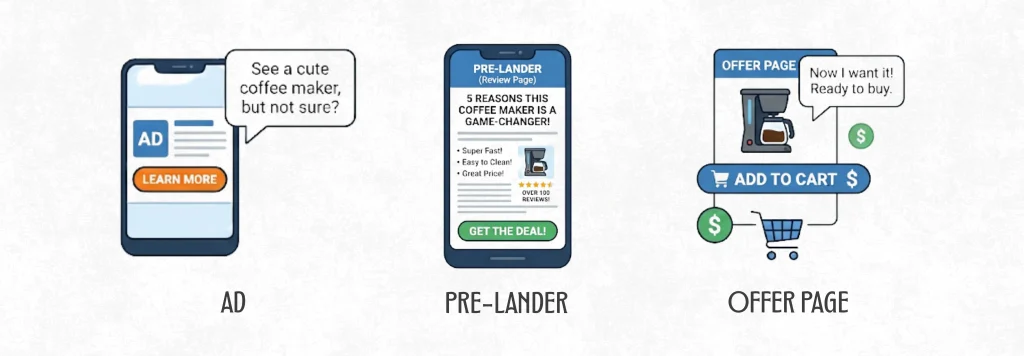
Popunder traffic is inherently passive, visitors discover the tab after switching windows, often with no memory of what triggered it. Sending that cold traffic directly to a hard-sell landing page tends to produce high bounce rates. A pre-lander closes that gap, turning an unexpected impression into an engaged visitor.
Why Do Pre-Landers Outperform Direct Linking on Popunder Traffic?
Pre-landers outperform direct linking because they rebuild context, filter out low-intent clicks, and improve advertiser-side trust, three things cold popunder traffic lacks by default. Here’s how each mechanism works:
- They rebuild context. Since the user never clicked with intent, the pre-lander creates a “reason” for arriving, a news-style hook, a personal story, or a comparison angle.
- They pre-qualify traffic. Only visitors who read through and click “continue” reach the offer, which raises the intent quality hitting the advertiser’s landing page.
- They reduce advertiser-side bounce. Many advertisers’ compliance and quality scores improve when traffic arrives pre-warmed, which can mean better payouts and fewer offer shutdowns.
- They enable native-style testing. You can A/B test angles, headlines, and hooks on the pre-lander without ever touching the advertiser’s actual landing page.
How Do You Build a Pre-Lander for Popunder Traffic?
You can build a pre-lander with a landing page builder, a static HTML/CSS template, or a CMS like WordPress. Whatever you pick, it should load in under 3 seconds on mobile and pass click data to your tracker. The right choice depends on how many variants you’ll test.
| Approach | Best for | Trade-off |
|---|---|---|
| Landing page builder | Beginners, fast launches | Heavier pages, monthly cost |
| Static HTML/CSS template | Speed and full control | Needs basic coding |
| WordPress + lightweight theme | Teams that already use WP | Plugins can slow load time |
Hosting and speed checklist:
- Use a domain that doesn’t look spammy, with HTTPS enabled.
- Host on a CDN-backed static host so the page loads close to the visitor.
- Compress images (WebP) and keep the page weight low.
- Skip heavy scripts, sliders, and web fonts you don’t need.
How Do Geo, Device, and OS Splits Affect Pre-Landers?
Popunder performance varies by geo, device, and operating system, so one pre-lander rarely fits every segment. Split campaigns and review results by segment before scaling.
- Geo: Language, currency, and local references change response. A pre-lander written for one country rarely converts in another without localization, and some verticals are restricted in certain regions.
- Device: Most popunder traffic skews mobile, so design mobile-first. Test desktop separately if you buy it.
- OS and browser: Android and iOS handle redirects, tabs, and rendering differently. Test on real devices for both.
- Offer fit: Make sure the offer is available for the geo, device, and OS you’re sending. Mismatches waste spend.
Practical approach: start with one geo and one device type, find a winning pre-lander, then clone the campaign for each new segment with a localized version.
What Makes a Pre-Lander Convert?
A high-converting pre-lander combines a believable hook, sub-3-second load time, a mobile-first layout, visible social proof, and one repeated call-to-action. Break each element down before you build:
1. Believable hook: The headline and opening lines should feel editorial, not promotional, a news snippet, a “local resident discovers…” angle, or a relatable pain point. Popunder audiences respond to curiosity far more than a direct offer.
- Example: “Local commuters are switching to this simple trick” works only if the offer actually matches.
- Fix: Lead with a specific, relatable problem or curiosity, and make sure the offer delivers on it. Test 3-5 headlines before touching the layout.
2. Fast load time: Popunder users are impatient by nature, they didn’t ask to see this tab. Anything over 2–3 seconds to load kills conversion. Compress images, avoid heavy scripts, and lean on lightweight HTML/CSS.
- Example: A 4 MB hero image and three tracking scripts push load past 5 seconds on 4G.
- Fix: Compress images to WebP, remove unused scripts, and test with a mobile speed tool. Aim for under 3 seconds.
3. Mobile-first layout: Most popunder inventory, including traffic run through PopCash, skews mobile. Design vertically, with large tap targets and short paragraphs.
- Example: A two-column desktop layout shrunk onto a phone leaves tiny text and hard-to-tap buttons.
- Fix: Single column, short paragraphs, and buttons large enough to tap with a thumb.
4. Social proof: Testimonials, comment sections (simulated only where compliant), review scores, or “X people viewed this today” counters build trust before the click-through.
- Example: Real review scores or verified customer feedback from the advertiser.
- Fix: Use only genuine, verifiable proof you’re allowed to show. Don’t fabricate testimonials, comments, or view counters.
5. Single, clear CTA: One button, repeated two to three times down the page. Multiple competing CTAs dilute conversion rate.
- Example: A page with “Buy now,” “Learn more,” and “Check price” competing for attention.
- Fix: One action, one label, repeated two or three times down the page.
What Mistakes Kill Pre-Lander Performance?
| Mistake | What it looks like | How to fix it |
|---|---|---|
| Too much text before the CTA | Five paragraphs before the first button | Put the first CTA within the first scroll; cut intro copy in half |
| Auto-playing audio or video | Sound starts on load | Remove autoplay; let users choose to play |
| Mismatched angle | Pre-lander promises a free trial, offer page asks for payment | Align headline, claim, and offer terms before launch |
| No mobile testing | Button hidden behind a banner on iOS | Test on real Android and iOS devices |
| Overly aggressive claims | “Guaranteed results in 24 hours” | Use claims the advertiser and policy allow; tone down promises |
| Broken tracking | Click ID lost on redirect | Test the full flow, including postback, before spending |
Compliance
Compliance protects your account standing with the ad network, the advertiser, and the regulators who oversee advertising. Rules vary by country, vertical, and platform, so treat this as a baseline and check the current policy for each offer.
Universal rules:
- Disclose that it’s advertising. A news-style or advertorial page shouldn’t pose as independent journalism. Label it clearly, such as “Advertisement” or “Sponsored.”
- Don’t fake proof. Fabricated testimonials, invented comment sections, fake news logos, and made-up view counters are deceptive and can get campaigns banned. Note: the current article mentions “simulated” comments “where compliant.” I’d remove or rewrite that line.
- Match the offer. The pre-lander’s claims must be supportable and consistent with the offer page.
- Follow endorsement rules. In the US, FTC guidance requires that endorsements be honest and that material connections be disclosed. Check equivalent rules in your target geos.
- Respect the network’s content policy. Review the PopCash ad compliance guidelines before launch.
By vertical:
- Nutra/health: Avoid disease-cure claims, before/after images that imply guaranteed results, and unverifiable medical statements. See your nutra advertising policy guide.
- Finance : Disclose risks and terms where required; avoid income guarantees.
- Dating: Use accurate descriptions and age-appropriate content; avoid misleading profile claims.
- Sweepstakes: Show eligibility rules, prize terms, and any required legal text.
Which Pre-Lander Structure Works Best for My Vertical?
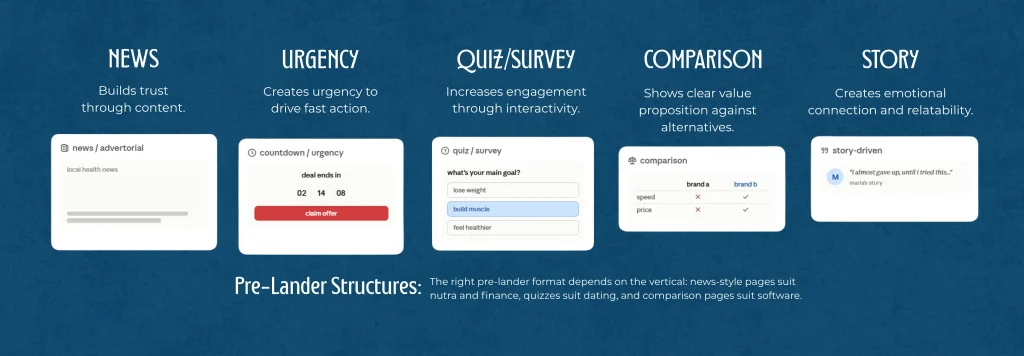
The right pre-lander format depends on the vertical: news-style pages suit nutra and finance, quizzes suit dating, and comparison pages suit software. Use the table below to match structure to offer type.
| Pre-Lander Type | Best For | Why It Works |
|---|---|---|
| News/Advertorial | Nutra, finance, sweepstakes | Feels editorial, lowers guard |
| Quiz/Survey | Dating, subscription offers | Increases engagement time, self-selects intent |
| Countdown/Urgency | E-commerce, flash offers | Creates urgency for passive traffic |
| Comparison | Software, VPN, antivirus | Builds perceived objectivity |
| Story-driven | Weight loss, self-improvement | Builds emotional buy-in before the ask |
What Mistakes Kill Pre-Lander Performance?
The most common pre-lander mistakes are burying the CTA under too much text, auto-playing media, and mismatching the pre-lander’s promise with the offer itself.
Watch out for:
| Mistake | What it looks like | How to fix it |
|---|---|---|
| Too much text before the CTA | Five paragraphs before the first button | Put the first CTA within the first scroll; cut intro copy in half |
| Auto-playing audio or video | Sound starts on load | Remove autoplay; let users choose to play |
| Mismatched angle | Pre-lander promises a free trial, offer page asks for payment | Align headline, claim, and offer terms before launch |
| No mobile testing | Button hidden behind a banner on iOS | Test on real Android and iOS devices |
| Overly aggressive claims | “Guaranteed results in 24 hours” | Use claims the advertiser and policy allow; tone down promises |
| Broken tracking | Click ID lost on redirect | Test the full flow, including postback, before spending |
Pre-Launch Checklist
- Loads in under 3 seconds on mobile
- Headline matches the offer’s actual promise
- Single, repeated CTA
- Compliant with vertical-specific ad policies
- Tested on both Android and iOS browsers
- Tracking pixels/postbacks fire correctly before redirect
FAQ
Do pre-landers actually increase ROI on popunder traffic?
Yes, in most tested verticals, nutra, sweepstakes, dating, and finance, pre-landers increase conversion rate by pre-qualifying cold traffic, which typically improves overall ROI even though some users drop off before reaching the offer.
How long should a pre-lander be?
Long enough to build context and trust, short enough to keep load time and read time low. Most high-performing pre-landers run one to one-and-a-half scrolls on mobile.
Can I use the same pre-lander for multiple offers?
Yes, as long as the offers share the same vertical and angle. Swapping the destination URL behind a proven pre-lander is a common way to test new offers quickly without rebuilding creative.
Do pre-landers hurt approval rates with advertisers?
No. Done correctly, they usually help, since advertisers receive warmer, more qualified clicks. Issues only arise when a pre-lander misrepresents the offer or violates the network’s compliance rules.
What’s the difference between a pre-lander and a landing page?
A pre-lander is a warm-up page that builds context before redirecting; the landing page is the advertiser’s actual offer or checkout page where the conversion happens.
Ready to Put This Into Practice?
Pre-landers only work if you’re sending them real popunder volume to test against. Join Popcash and start running your pre-lander variants against live, global popunder traffic today.
