

Popunder traffic works for affiliate marketing because it puts your offer in front of a visitor without competing for space on the page they’re already reading.
To use it effectively: pick a vertical that matches broad-appeal, low-friction offers (sweepstakes, VPN, dating, utilities, gambling, finance), run CPM bidding so you control cost per view from day one, target by GEO, device, and OS instead of running broad, and optimize daily using whitelist/blacklist data rather than waiting for a campaign to “settle.”
Affiliates who treat popunders as a volume-and-testing channel first, and a scaling channel second, get the best ROI from the format.
The rest of this guide walks through what popunder traffic actually is, which offers it’s suited to, and how to set up, target, and optimize a campaign step by step.
TL;DR
Popunder traffic works for affiliate marketing because it reaches visitors without interrupting the page they’re on, making it cheap, high-volume, and effective for broad-appeal offers (sweepstakes, dating, gambling, finance, utilities). To use it well: always send traffic to a pre-lander first (never straight to the offer), start with manual CPM bidding to control cost while testing, narrow your GEO/device/OS targeting before launch rather than after, and optimize using source-level whitelist/blacklist data once you have enough volume.
What Is Popunder Traffic and How Does It Work?
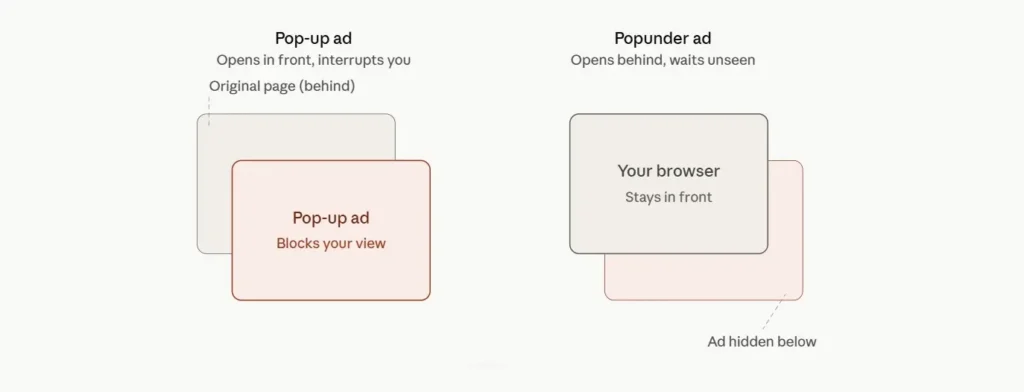
A popunder is an ad format that opens in a new browser window or tab behind the page a visitor is already on. Unlike a pop-up, it doesn’t interrupt the current page, the visitor only sees it after they close or minimize their active window. That single difference is why popunders convert well for affiliate offers: the visitor engages with the ad on their own terms, once their attention is already free, rather than being forced to dismiss it mid-read. New to the format? Read our complete guide to popunder advertising.
Most popunder networks, including PopCash, cap delivery to one popunder per unique visitor within a 24-hour window. That cap matters for affiliates because it keeps the traffic source viable long-term, publishers don’t burn out their audience, so the volume and quality of available traffic stays consistent instead of degrading the way overexposed formats do.
Why Use Popunder Traffic for Affiliate Marketing?
Popunder traffic earns a permanent spot in most affiliates’ media mix for a few concrete reasons:
- Volume at low cost. Because popunders don’t compete for on-page real estate, publishers can monetize nearly any page, which keeps supply, and therefore CPMs, lower than in-feed or native formats. That makes popunders one of the cheapest ways to get large-scale traffic for split-testing.
- Full-page attention. The ad gets the entire browser window, not a banner-sized slice of it, which suits offers that need a landing page or pre-lander to tell a story before the click.
- Works across mainstream and adult verticals. Popunder inventory isn’t restricted to a single niche the way some ad formats are, so the same buying skills transfer across offer types.
- Fast to test, fast to scale. Low minimum deposits (PopCash’s is $5) and self-serve dashboards mean an affiliate can go from idea to live traffic in the same day, then scale winning combinations without a lengthy approval cycle.
- Global reach, including harder-to-monetize GEOs. Popunder networks tend to have deep inventory in tier 2 and tier 3 countries where other formats are thin, which is exactly where CPA offers in sweepstakes, utilities, and finance often pay the best margins relative to traffic cost.
What Are the Best Verticals and Offers for Popunder Traffic?
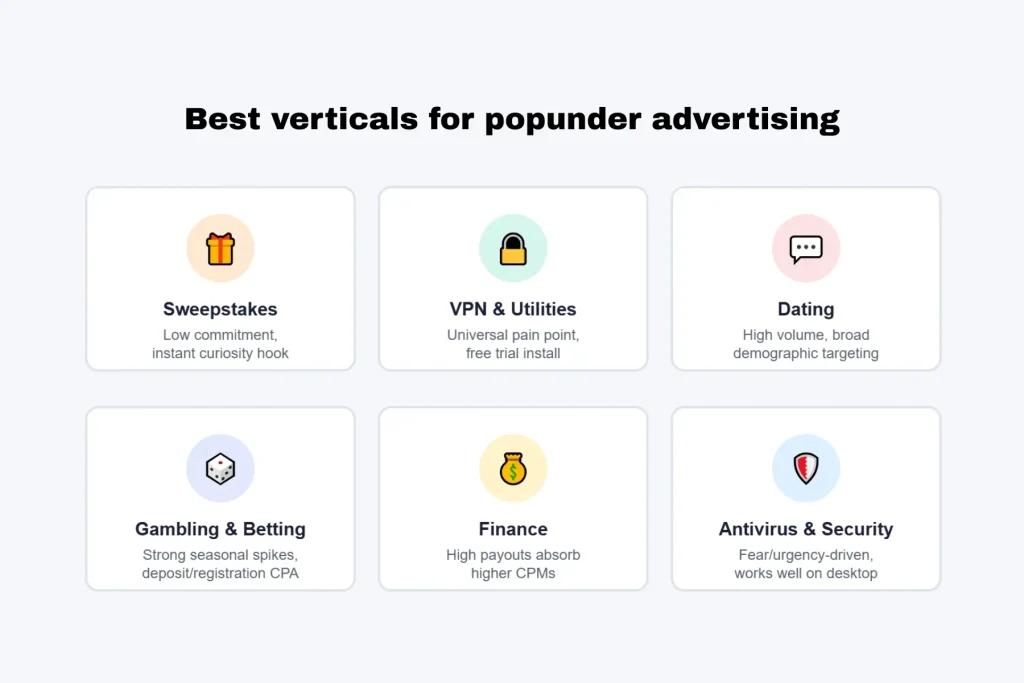
Popunder traffic performs best on offers that don’t require the visitor to already be in a buying mindset, the traffic is interruption-based, so the offer needs broad appeal and a short, simple conversion path.
| Vertical | Why it fits | Offer type to test first |
|---|---|---|
| Sweepstakes & giveaways | Low commitment, instant curiosity hook | Single-step email/SMS submit |
| VPN & software utilities | Universal pain point (privacy, device cleanup) | Free trial or freemium install |
| Dating | High volume, broad demographic targeting | SOI (single opt-in) |
| Gambling & betting | Strong seasonal spikes (majors, tournaments, World Cup-style events) | Deposit or registration CPA |
| Finance (loans, crypto, trading) | High payouts absorb higher CPMs | Lead form |
| Utilities | Fear/urgency-driven, works well on desktop | Download + scan |
Nutra and e-commerce offers can work too, but they typically need a stronger pre-lander between the popunder and the offer page, since the format doesn’t pre-qualify intent the way search traffic does.
How Do You Set Up a Popunder Campaign for Affiliate Offers? (7 Steps)
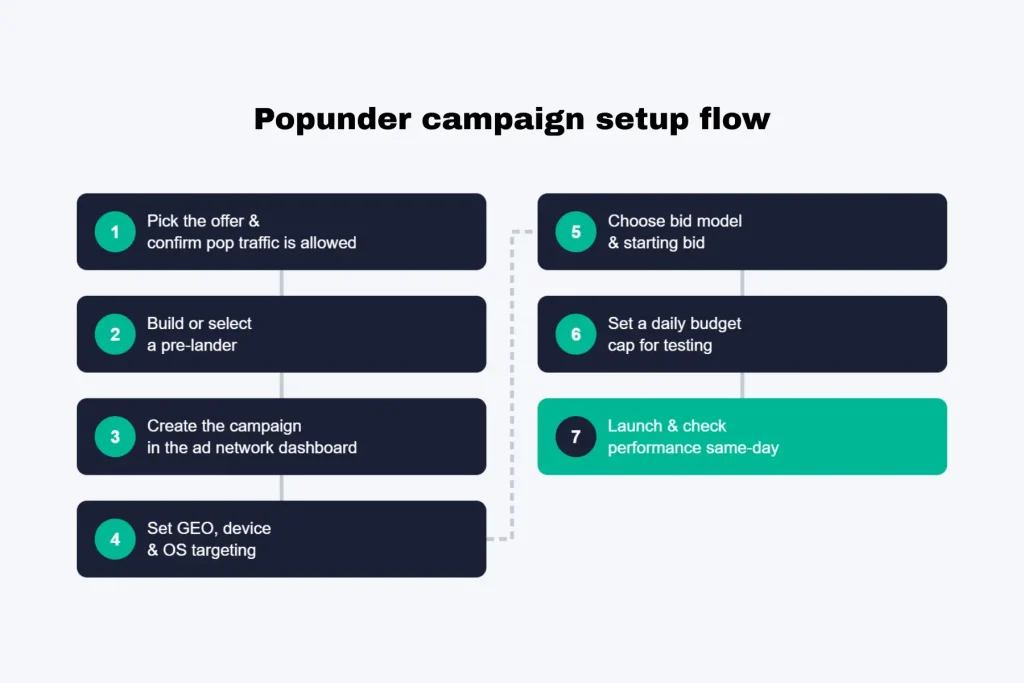
1. Pick the offer and confirm the traffic type it allows. Check your affiliate network’s terms for pop traffic, most CPA networks allow it, but some restrict incentivized or adult-adjacent verticals to specific traffic sources.
2. Build or select a pre-lander. Because popunder visitors land with zero prior context, a short pre-lander that frames the offer (a quiz, a “your device may be at risk” style hook, a countdown) consistently outperforms sending popunder traffic straight to a raw offer page.
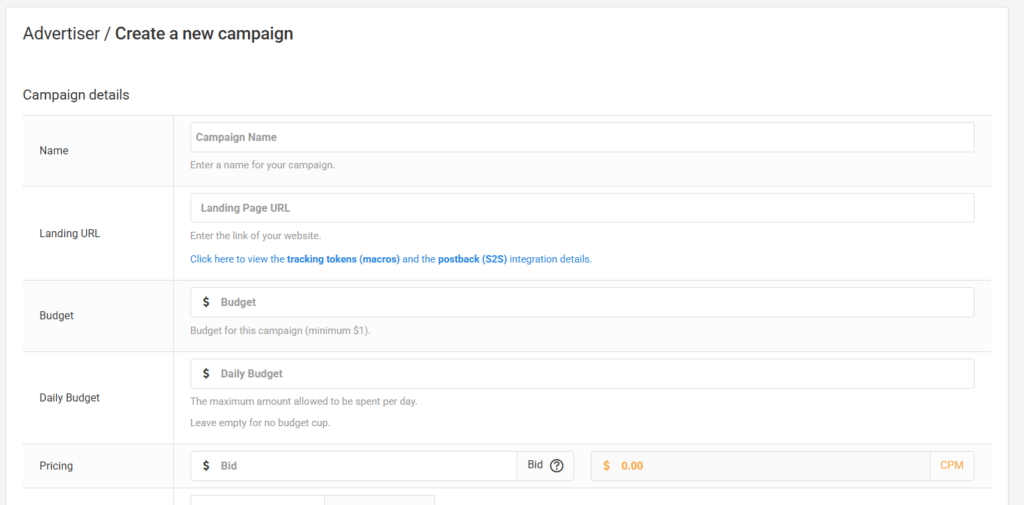
3. Create the campaign in your ad network dashboard. In PopCash, this means going to Campaigns → Create New Campaign, naming it clearly (offer + GEO + date, e.g., “VPN-US-Aug26”), and pasting your tracking link with sub-ID macros so every click reports back to your tracker.
4. Set your GEO, device, and OS targeting before launch, not after, see the next section.
5. Choose your bid model and starting bid, using network-suggested bids for the GEO as a baseline rather than guessing. Learn how to win more auctions without outspending competitors.
6. Set a daily budget cap you’re comfortable losing during the testing phase, a popunder test should be sized to reach statistical significance on your tracker, not to “see what happens.”
7. Launch, then check performance within hours, not days. Popunder volume is high enough that early signal (CTR to the pre-lander, then pre-lander to offer) usually appears the same day.
Once your campaign is live, the setup work is done and the real work begins: reading the data. A confirmed offer, a pre-lander that frames it, tight targeting, a sensible starting bid, and a capped test budget give you a clean baseline. Every change you make from here, whether to the bid, the GEO, or the pre-lander, can then be traced to a result instead of guessed at. Next, let’s look at which targeting layers deserve the most attention.
What Targeting Options Work Best for Popunder Campaigns? (GEO, Device, OS)
Popunder networks let you narrow delivery well past just country. The targeting layers that move the needle most for affiliate campaigns:
- GEO: the single biggest lever on both cost and payout; tier 1 GEOs cost more but often pay more per conversion, tier 2/3 GEOs cost less and suit high-volume CPA offers.
- Device type: desktop and mobile popunder traffic convert differently; software and VPN offers often skew desktop, while sweepstakes and dating often skew mobile.
- OS and browser: critical for software, extension, or app-install offers that only work on specific platforms.
- Vertical/category exclusions: blocking adult or gambling inventory (or the reverse, targeting only it) if your offer terms require it.
- Connection type: useful for filtering out low-quality traffic on offers sensitive to lead fraud, like finance or lead-gen forms.
Layer targeting narrowly at launch, then widen only the dimensions that are already showing positive signal, widening everything at once makes it impossible to tell which change caused a performance shift.
How Much Does Popunder Traffic Cost? (CPM Benchmarks 2026)
CPM (cost per mille): you pay per 1,000 impressions regardless of whether the visitor engages further. Best when you already know a GEO/vertical combination converts and you want predictable volume.
| Tier | Avg CPM | CPM range |
|---|---|---|
| Tier 1 | $0.54 | $0.25–$0.82 |
| Tier 2 | $0.40 | $0.20–$0.60 |
| Tier 3 | $0.35 | $0.20–$0.87 |
Source: PopCash traffic inventory export (240 GEOs, 39.9M impressions), exported November 2026. CPM in USD.
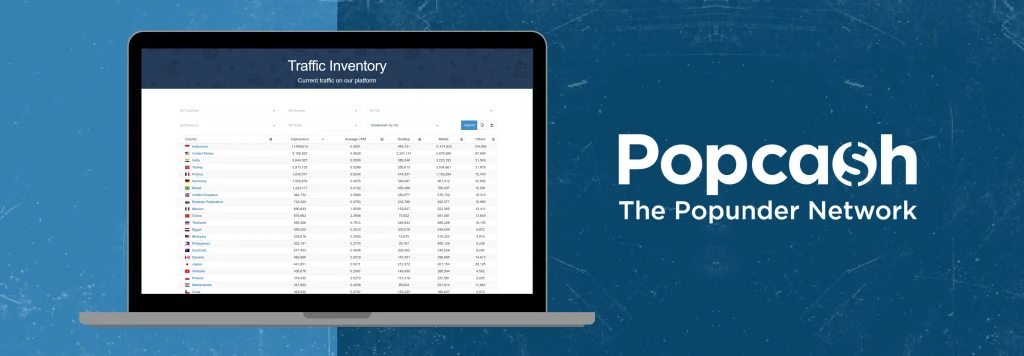
Always check the current rates and volumes of your desired targeting before running an ad campaign, via the PopCash traffic inventory.
Treat these numbers as a starting point, not a target. The gap between tier averages is fairly narrow ($0.35 to $0.54), so cost alone shouldn’t decide which GEO you test first. What matters is the margin between your payout per conversion and what it costs to earn it.
Use the averages to set a realistic starting bid, and work out your break-even CPM before you launch so you know how much room you have to scale. Then let your own tracker data, not the benchmark, tell you when to raise or lower the bid.
How Do You Optimize a Popunder Campaign for Higher ROI?
Optimization on popunder traffic is mostly about controlling where your budget goes at the source level, since the ad creative itself is minimal (the popunder just opens your pre-lander or offer URL).
- Use automated whitelist/blacklist rules. Set rules that automatically blacklist sources below your target ROI threshold and whitelist ones above it, based on a minimum spend or click threshold so you’re not making decisions on tiny sample sizes.
- Watch CTR from popunder to pre-lander, then pre-lander to offer, separately. If pre-lander CTR is healthy but offer conversion is weak, the problem is the offer or landing page, not the traffic source.
- Test pre-landers before testing bids. A pre-lander that better matches the traffic’s intent usually moves conversion rate more than a bid adjustment does.
- Re-check GEO performance weekly, not just at launch, currency shifts, seasonality, and payout changes on the affiliate network side can flip a GEO’s profitability without any change on your end.
- Cap frequency and dayparting where the network allows it, to avoid oversaturating a working source and driving its performance down over time.
What Are the Most Common Popunder Traffic Mistakes?
- Sending traffic straight to the offer with no pre-lander. This is the single biggest lever affiliates leave on the table with popunder traffic.
- Targeting too broadly at launch. Wide GEO and device targeting on day one makes it impossible to tell which segment is actually working.
- Judging a campaign after a few hundred impressions. Popunder CPMs are low specifically because volume is high, let the campaign reach a sample size large enough to be meaningful before pausing it.
- Ignoring source-level data. The publisher/source ID is often the highest-leverage optimization lever on pop traffic; skipping whitelist/blacklist management leaves easy ROI on the table.
FAQ
Start with sweepstakes or a VPN/utility free trial. Both have a low-friction, single-step conversion (an email or SMS submit, or a free install), which suits traffic that isn’t actively shopping. Dating with an SOI offer is a close third. Avoid nutra and e-commerce at first, since they need a stronger pre-lander. Finance has higher CPMs and is more sensitive to lead fraud. Pick one vertical, one GEO and one device, then expand once the data shows what works.
Yes, for offers with broad appeal and a short conversion path: sweepstakes, VPN, dating, gambling, and finance in particular. It’s less suited to offers that require the visitor to already be in a research or buying mindset, since popunder traffic is interruption-based rather than intent-based.
Cost depends on GEO, device, and bidding model. Tier 1 GEOs on CPM pricing generally cost more per thousand views than tier 2/3 GEOs, but minimum deposits to start testing are low, PopCash’s minimum deposit, for example, is just $5.
A pre-lander significantly improves conversion rates on popunder traffic because visitors land with no prior context about the offer. Sending traffic directly to a raw offer page is one of the most common mistakes affiliates make with this format.
A pop-up opens on top of the current browser window and interrupts what the visitor is doing. A popunder opens behind the current window and is only seen once the visitor closes or minimizes their active tab, which is why it tends to have a less disruptive user experience and a longer-lasting traffic source.
Most dedicated popunder networks, including PopCash, limit delivery to one popunder per unique visitor per 24 hours. This protects traffic quality over time by preventing publishers from overexposing their audience.
A good conversion rate is one that pays more than the traffic costs. There’s no single benchmark, because it depends on the offer, the GEO and the pre-lander.
Ready to Test Popunder Traffic? Start a PopCash Campaign
If you’re an affiliate ready to buy popunder traffic: Create your first PopCash campaign → self-serve dashboard, $5 minimum deposit, live traffic same day.
