

Popunder ads are one of the oldest, most misunderstood, and, when used correctly, most profitable ad formats in online advertising. If you’ve ever closed your browser and noticed a new tab or window sitting quietly behind it, you’ve encountered a popunder.
This guide breaks down exactly what popunder ads are, how they work, why advertisers and publishers still use them today, and how to run them effectively.
Key Takeaways
– Popunder ads open behind the active browser window, making them less intrusive than pop-ups.
– They’re sold mainly on a CPM basis and offer strong scale at a low cost.
– They work best for direct-response offers: software, VPN, dating, sweepstakes, finance, and iGaming.
– Success depends on strong landing pages, smart targeting, frequency capping, and continuous testing.
– When run through a quality ad network with proper fraud filtering, popunders remain a reliable, high-volume traffic source in modern advertising.
What Is a Popunder Ad?
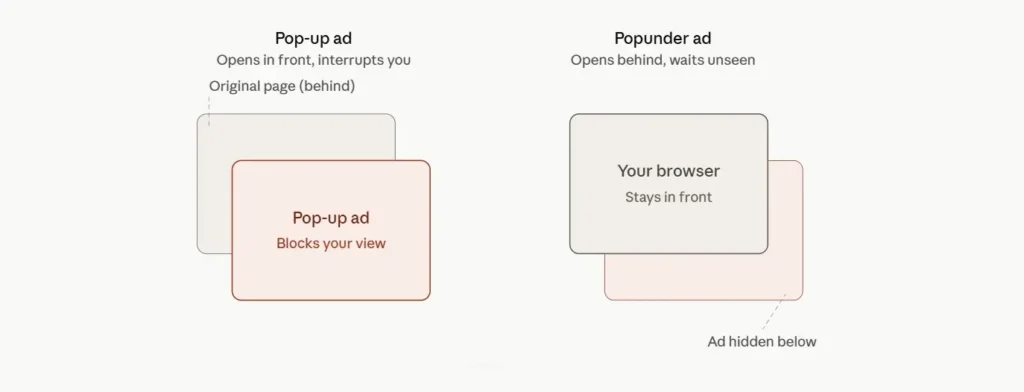
A popunder ad is a full-page advertisement that opens in a new browser window or tab positioned behind the page the user is currently viewing. Unlike a pop-up, which appears in front of the active window and interrupts the user immediately, a popunder stays hidden until the user closes, minimizes, or switches away from their current window.
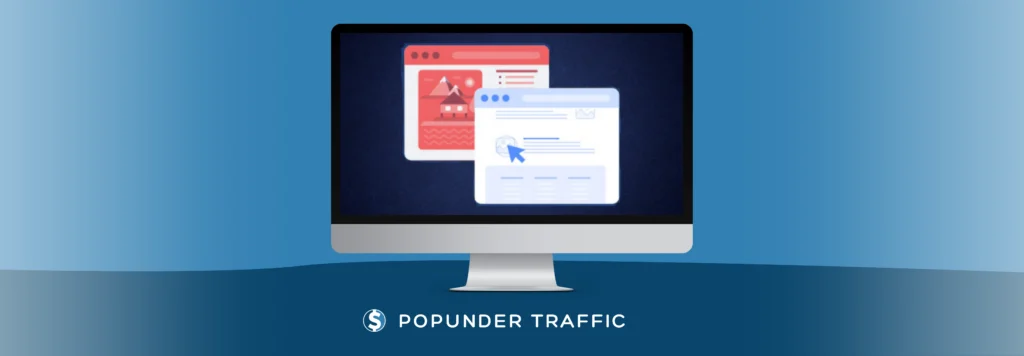
In short: a pop-up interrupts. A popunder waits.
This single difference is why popunders are considered a less intrusive format than pop-ups, and why they remain a staple traffic-monetization tool for publishers across entertainment, streaming, gaming, and utility websites.
Popunders, at a Glance
| Feature | Popunder Ads |
|---|---|
| Best for | Direct-response / performance campaigns |
| Pricing | CPM (primarily) |
| Opens | Behind the active browser window |
| Intrusive | Less than pop-ups |
| Works best for | VPNs, software, iGaming, finance |
| Devices | Desktop and some mobile environments |
| Goal | Conversions and scale |
How Do Popunder Ads Work?
The mechanics are straightforward:
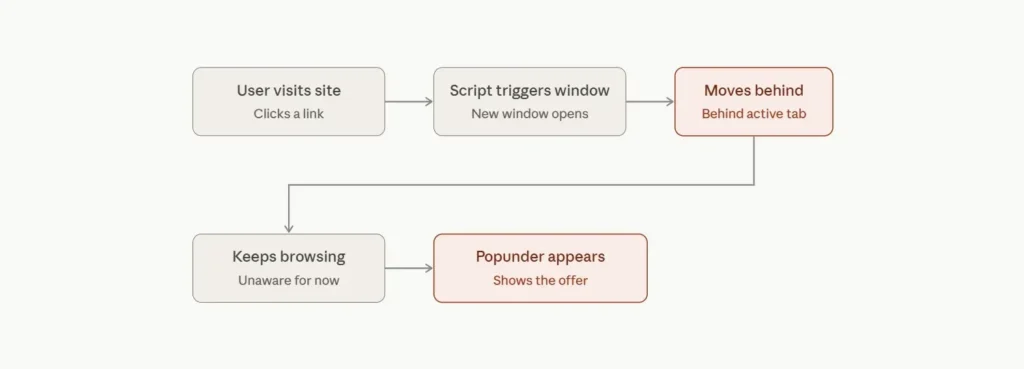
- A user visits a publisher’s website (or clicks a link, image, or button).
- A script on the page triggers a new browser window to open.
- The browser automatically sends that new window behind the current one.
- The user continues browsing normally, unaware of the new window until they close or minimize their active tab.
- When the user does eventually see it, the popunder displays the advertiser’s landing page, offer, or app install prompt.
How Do Popunder Ads Work? For example: A VPN advertiser buys 500,000 popunder impressions in Germany. Users browsing entertainment sites later see the VPN landing page after closing their tabs. With a well-optimized pre-lander and localized offer, the campaign generates subscriptions at a competitive CPA.
Popunders are typically triggered by:
- A click anywhere on the page (most common)
- A specific button, link, or ad placement
- Page load, after a delay (less common, more aggressive)
Ad networks manage frequency capping so the same user doesn’t see repeated popunders in a single session, which protects both user experience and campaign performance.
What Is the Difference Between Popunder Ads and Pop-Up Ads?
| Feature | Popunder | Pop-up |
|---|---|---|
| Window position | Opens behind the active window | Opens in front of the active window |
| User disruption | Low, seen only after the user finishes their session | High, interrupts immediately |
| Perceived intrusiveness | Lower | Higher |
| Browser/ad-blocker targeting | Often less aggressively blocked | Frequently blocked by default |
| Typical CTR | Lower, but often higher intent since user chooses to engage later | Higher initial visibility, but higher bounce |
| Common use cases | Software downloads, sweepstakes, VPNs, gaming, dating, finance offers | Newsletter signups, exit offers, coupon codes |
Both formats fall under the broader “onclick” or “pop traffic” category, but popunders are generally viewed as the more advertiser- and user-friendly of the two.
Why Advertisers Use Popunder Ads: Pros and Cons Overview
Popunder traffic remains popular for several reasons:
- Massive scale. Publishers running popunders can generate huge volumes of impressions, making the format ideal for advertisers who need volume to optimize campaigns quickly.
- Low cost per impression. Popunders are typically sold on a CPM (cost per mille) basis and tend to be cheaper than display or native placements.
- High visibility. Because the ad occupies the full browser window when the user does see it, there’s no competing content, no banner blindness, and no scroll-past risk.
- Works well for direct-response offers. Verticals like software downloads, VPNs, sweepstakes, dating, gaming, and finance see strong results because these offers benefit from a full, uncluttered landing page.
- Compatible with smartlink and pre-landing flows. Advertisers can pair popunders with pre-landers, quizzes, or smartlinks to pre-qualify traffic before the offer page.
Popunder Advertising Pros & Cons, at a Glance
| Criteria | ✅ Pros | ❌ Cons |
|---|---|---|
| Cost | Low CPMs and affordable traffic | Costs can rise in competitive GEOs |
| Reach | Massive traffic volume | Quality varies by traffic source |
| Visibility | Full-page ad with no competing content | User sees the ad only after leaving the current page |
| User Experience | Less disruptive than pop-ups | Still considered intrusive by some users |
| Performance | Strong for conversions and affiliate marketing | Lower engagement than intent-driven channels like search |
| Targeting | Supports GEO, device, OS, browser, and language targeting | Requires continuous optimization for best results |
| Scalability | Easy to scale successful campaigns | Can spend budgets quickly without proper controls |
| Compatibility | Works well with pre-landers and Smartlinks | Some browsers and ad blockers may limit delivery |
Who Should Use Popunder Ads?
Popunders tend to perform best for:
- Affiliate marketers running CPA/CPL offers (VPN, antivirus, sweepstakes, dating, subscription trials)
- App and software developers driving installs at scale
- iGaming and betting advertisers targeting broad audiences
- Finance and insurance advertisers using lead-gen funnels
- E-commerce advertisers testing new offers cheaply before scaling to other formats
Brand advertisers focused purely on awareness or premium placements typically prefer display, video, or native ads instead, since popunders are a direct-response format first.
How Much Do Popunder Ads Cost?
Most ad networks sell popunder traffic through one of the following models:
- CPM (Cost Per Mille): You pay per 1,000 impressions. Most common model for popunders.
- CPC (Cost Per Click): Less common for popunders since the format isn’t click-based by nature, but some networks offer it.
- CPA (Cost Per Action): Available through some networks or affiliate arrangements, where you pay only for conversions.
CPM rates for popunder traffic are generally lower than banner or native CPMs, which is part of why the format remains attractive for testing offers at scale.
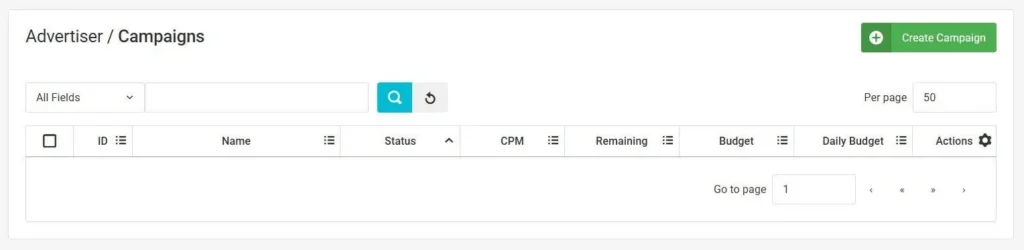
How to Create a Popunder Ad Campaign(Step-by-Step: Launching a PopCash Campaign)

Name the campaign & add landing page URL. Use descriptive names (e.g., “Sweeps LATAM”) and optionally add tracking tokens to pass data to your tracker.
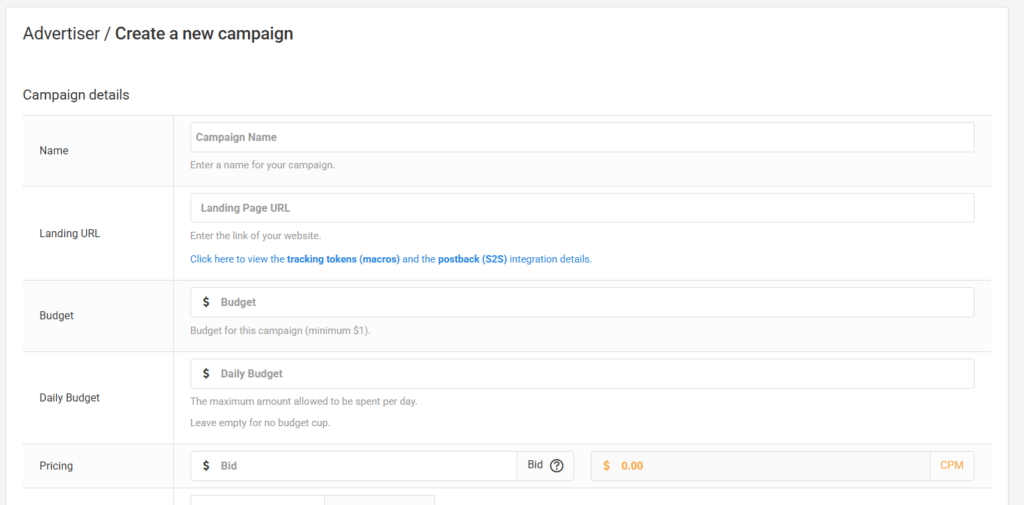
Set budget & daily spend limit. Define a total budget; leave the daily cap blank for unrestricted early testing.
Set your CPM bid. PopCash uses Cost Per Mille (cost per 1,000 impressions). Check the live traffic inventory tool to gauge competitive rates before locking in a bid.
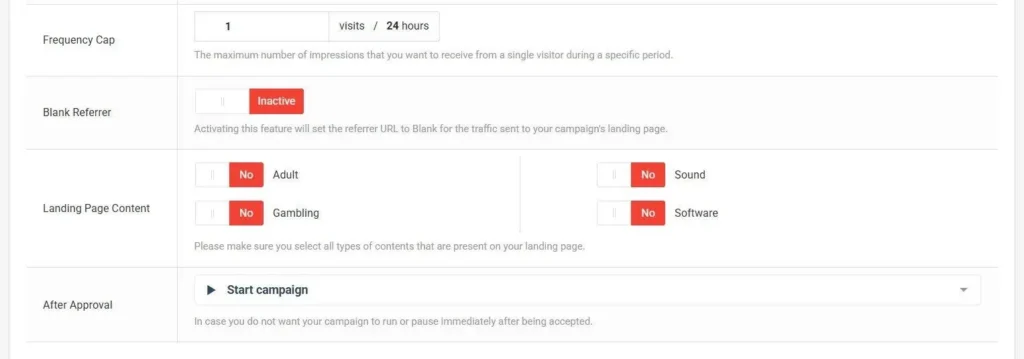
Apply a frequency cap. Limits how often one visitor sees your ad in 24 hours (up to 99). Lower caps typically preserve budget and reduce ad fatigue.
Configure blank referrer & content type. Blank referrer hides PopCash as the traffic source; content type (Adult, Gaming, Software, etc.) improves audience matching.
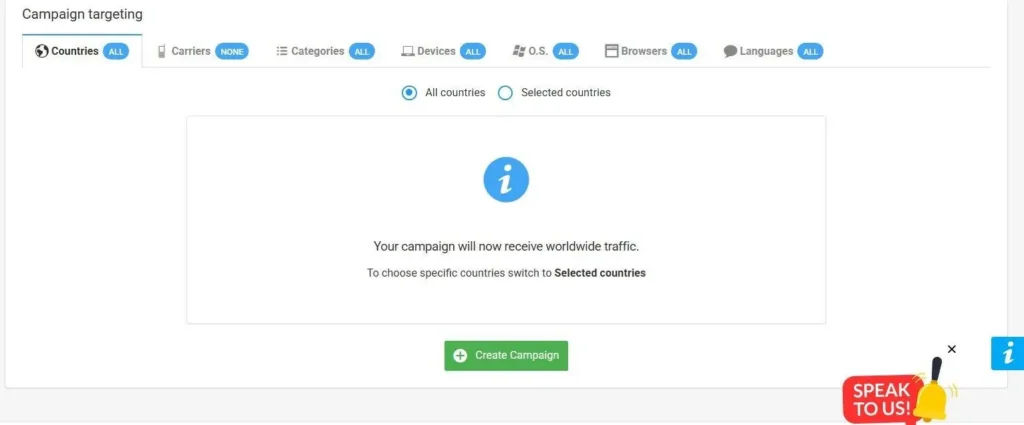
Target your audience. Narrow by country, carrier/connection type, content category, device, OS, browser, and language.
Full PopCash tutorial on how to create a popunder ad campaign can be found in our Help Center.
What Are the Best Practices for Running Popunder Ad Campaigns?
- Use a strong, fast-loading landing page. Since the user sees the full page with no distractions, page speed and first impression matter enormously.
- Apply frequency capping. Avoid showing the same user multiple popunders in a short window to protect user experience and campaign metrics.
- Target by GEO, device, and OS. Popunder performance varies significantly by region and device type, segment and test accordingly.
- Use pre-landers for compliance-sensitive verticals. Finance, dating, and sweepstakes offers often convert better, and stay compliant, with a pre-lander that qualifies the user first.
- Monitor traffic quality. Work with reputable ad networks that filter bot traffic and enforce quality controls on publisher inventory.
- A/B test creatives and offers continuously. Popunder traffic volume makes it easy to run statistically significant split tests quickly.
- Set bid caps and budgets carefully. Because CPMs are low and volume is high, campaigns can spend budget fast, set daily caps while testing.
>> For a more detailed solution on how to bid effective check out our popunder win rate optimization guide.
Are Popunder Ads Still Effective in Modern Digital Advertising?
Yes, with the right strategy. While popunders are sometimes dismissed as an “old-school” format, they remain a core traffic source for performance marketers because:
- Volume and reach are still unmatched for direct-response campaigns.
- Costs remain low relative to display and native.
- The format pairs well with mobile app install and subscription-based offers, two of the fastest-growing verticals in performance marketing.
- Modern ad networks now offer better targeting, fraud filtering, and creative optimization tools than in years past, improving overall ROI.
The key is treating popunder traffic as a performance channel, with clear KPIs, testing discipline, and quality inventory, not a “set and forget” placement.
Are Popunder Ads Legal and Safe to Use?
Yes. Popunder ads are a legitimate advertising format used by many advertising networks and publishers. Their legality depends on how they’re implemented, the claims made in the advertisement, and whether advertisers comply with applicable privacy and consumer protection laws.
Industry organizations such as the IAB have published best practices for responsible pop-up and popunder advertising, including recommendations for frequency capping and user controls.
Advertisers should:
- Follow the advertising policies of their ad network and comply with applicable privacy laws such as the GDPR when targeting users in the European Union.
- Ensure all advertising claims are truthful, substantiated, and not misleading, in line with consumer protection regulations.
- Comply with industry-specific regulations when promoting products or services in regulated sectors such as finance, gambling, healthcare, or pharmaceuticals.
- Respect user experience by applying reasonable frequency caps and avoiding deceptive or abusive implementations, which may violate industry standards or lead to account restrictions.
Common Popunder Advertising Mistakes
Popunder ads can deliver massive scale and low CPMs, but they’re also easy to run inefficiently if you’re not careful. Because popunders open behind the active browser window, they get judged on different terms than banner or native ads: engagement, timing, and targeting mistakes tend to show up fast in wasted spend rather than just low CTR.
| Mistake | Why It Hurts Performance |
|---|---|
| Sending traffic to a slow landing page | Users may leave before the page loads, reducing conversions and increasing bounce rates. |
| Ignoring frequency capping | Showing too many popunders to the same user can lead to ad fatigue and a poor user experience. |
| Targeting too broad an audience | Running campaigns across all GEOs, devices, or browsers without segmentation often wastes budget. |
| Using the same landing page for every device | Desktop and mobile users behave differently, so optimized, device-specific pages typically perform better. |
| Not testing multiple landing pages | Relying on a single page limits opportunities to improve conversion rates through A/B testing. |
| Choosing low-quality traffic sources | Poor-quality publisher inventory can result in bot traffic, accidental visits, and low conversion rates. |
| Failing to optimize campaigns regularly | Successful popunder campaigns require ongoing adjustments to bids, targeting, and placements based on performance data. |
| Setting unlimited budgets during testing | High traffic volumes can exhaust budgets quickly before enough optimization data is collected. |
Popunder Advertising FAQ
A popunder ad is a full-page ad that opens in a new browser window behind the page a user is currently viewing, becoming visible only after they close or minimize their active window.
A pop-up opens in front of the current window and interrupts browsing immediately. A popunder opens behind the current window, so it doesn’t disrupt the user’s session until later.
Popunder ads are typically priced on a CPM basis and are generally cheaper than display or native ad CPMs, making them a low-cost option for testing offers at scale.
Yes. Popunders remain effective for direct-response verticals like software, VPNs, sweepstakes, dating, and iGaming due to their scale, low cost, and full-page visibility.
Some ad blockers do target popunders, but they are generally less aggressively blocked than pop-ups since browsers historically treat “new window” behavior differently from an in-page interstitial. Effectiveness still varies by browser and blocker settings.
VPN, antivirus, software downloads, sweepstakes, dating, finance, and iGaming offers tend to perform best, since these direct-response verticals benefit from full-page, distraction-free landing pages.
It’s not required, but pre-landers often improve conversion rates and compliance for sensitive verticals like finance, dating, and sweepstakes by pre-qualifying users before they reach the offer.
Launch Your First Popunder Campaign!
Popunder advertising rewards advertisers who stay disciplined. Pick a direct-response offer, pair it with a fast landing page, target by GEO, device, and OS, cap your frequency, and test continuously. Do that, and popunders give you scale at a low CPM that few other formats can match.
PopCash gives you the tools to put this into practice, from live traffic inventory and detailed targeting to frequency capping and fraud filtering. Set up your first campaign in a few minutes and start testing with a controlled budget.
Start your first PopCash ad campaign today → Sign up now!
