

If you run a website, you already know the awkward truth about ad revenue: the format that earns the most is rarely the one you’d pick for your visitors, and the one visitors tolerate best rarely pays the bills. The real question is which ad format fits your traffic, your audience, and your goals, and whether a mix beats going all-in on one.
This guide compares popunders with the other formats publishers use most, so you can decide what to test first. We’ll cover how each format works, where it shines, where it falls short, and how to combine them without scaring off your visitors.
TL;DR
- Popunder ads open a new window behind the page the visitor is viewing. They are famous for high revenue per visitor and zero layout clutter, but they need careful frequency control.
- Banners, native ads, push notifications and interstitials each win in different situations. None of them is “best” across the board.
- Most publishers earn more with a mix of formats than with any single one. A common pattern is popunders plus one on-page format plus push.
- Start with one new format at a time, measure for 7 to 14 days, then decide.
How do popunders compare to other ad formats?
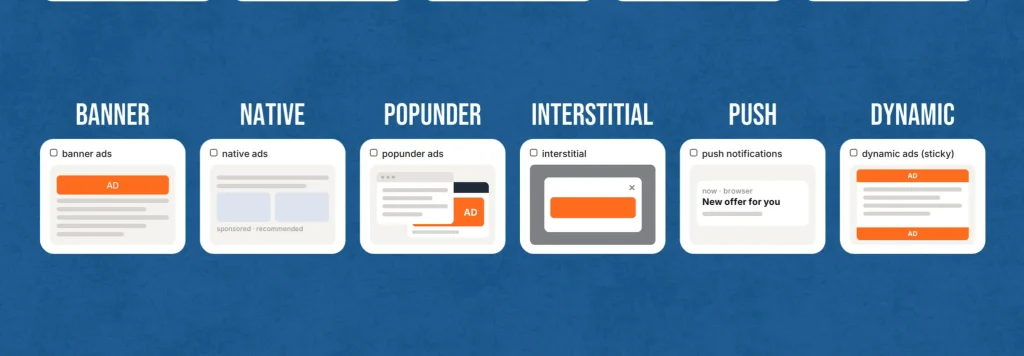
Popunders tend to deliver the highest revenue per visitor with the lowest on-page footprint, while banners and native ads win on user experience and push wins on repeat reach. Here is the quick side-by-side.

A popunder ad is an ad that opens in a new browser window or tab underneath the page the visitor is currently on. The visitor keeps reading, and finds the ad when they close or switch away from the window.
| Format | Revenue potential | User disruption | Best for |
|---|---|---|---|
| Popunder | High | Low to medium (off-page) | High-traffic sites, tools, streaming, file sharing |
| Display banner | Low to medium | Low | Content-heavy sites with stable layouts |
| Native ad | Medium | Low | Blogs, news, editorial content |
| Push notification | Medium to high (compounds over time) | Medium | Sites with repeat visitors |
| Interstitial | Medium to high | High | Apps, games, multi-page flows |
| Dynamic (sticky) | Medium | Low | Long-scroll content pages, mobile-heavy sites |
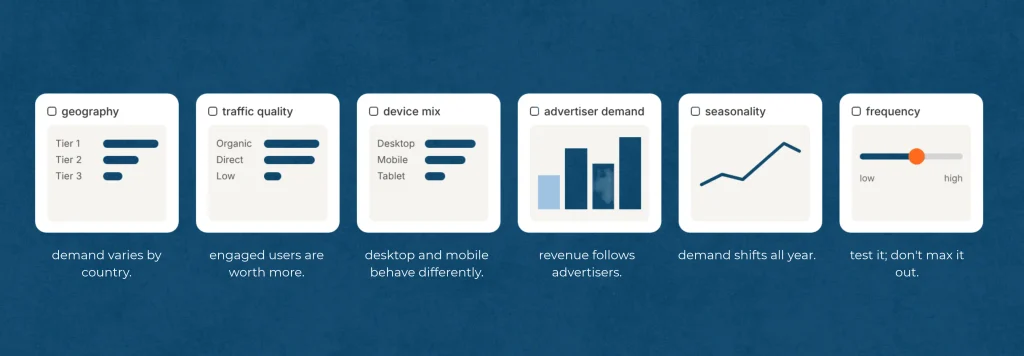
These are directional ratings, not guarantees. Actual numbers depend on your geo, traffic source, device mix and niche.
If you only remember one thing from the table: revenue and disruption usually move together, and popunders are the unusual case where they don’t, because the ad sits off the page.
Popunders usually earn more per visitor than banners, because one popunder impression pays like a full-page view while a banner is competing for a tiny slice of attention.
Banners ads are the old reliable. They are easy to place and almost every ad network supports them. The catch is banner blindness: people have trained themselves to ignore the rectangles at the top and side of the page, so click-through rates stay low.
That said, banners cost you very little in terms of visitor goodwill. If your site is a polished magazine-style publication, banners may fit your brand better.
Our take: banners are a decent base layer, not a revenue engine.
Popunder vs native ads: which is better for your readers?
Native ads are better for reader experience, and popunders are better for raw monetization of traffic that doesn’t convert on-page.
Native ads are designed to look like your content: sponsored recommendations, “you may also like” blocks and so on. Readers tend to accept them because they feel less like an ad.
The trade-off is dependency on content context. Native works best on article pages with a reader who is already browsing. On a utility page, a download page or a video player, there often isn’t room for it.
A pairing that works well for a lot of publishers: native on content pages, popunders on high-volume landing or tool pages. Nobody says you have to pick a side.
Popunder vs push notifications: which keeps working longer?
Push notifications keep working longer, because a subscriber can be reached again and again; popunders monetize the visit happening right now.
Push builds an asset. Each opt-in is a person you can reach later without paying for the traffic again. That is powerful for sites with loyal, returning audiences.
It’s also slower. You need to earn the opt-in, and subscribers churn if you send too often or the ads feel irrelevant. Popunders, by contrast, start earning from the first session.
The two formats complement each other nicely. Use popunders to monetize today’s traffic and push to build tomorrow’s.
Popunder vs interstitials: which is less intrusive?
Popunders are generally less intrusive than interstitials, because they never block the content the visitor came to see.
Interstitials are full-screen ads that appear between actions, like between game levels or page loads. They can earn well in the right setting, especially in apps and games where natural pauses exist.
On regular websites, though, a full-screen ad right when someone lands is a fast way to lose them. The Coalition for Better Ads publishes Better Ads Standards that flag certain intrusive full-screen formats, so it pays to read them before you roll anything out.
If your priority is keeping people on the page, a popunder is the gentler option. If your product has natural breaks, an interstitial can work.
Popunder vs dynamic ads: which holds attention better?
Dynamic (sticky) ads keep your monetization visible for the whole session, while popunders monetize the moment a visitor arrives, without taking up any space on the page.
Dynamic ads are banners pinned to the top or bottom of the screen. They stay in view as the visitor scrolls. Because the ad never leaves the viewport, it gets far more exposure than a standard banner that scrolls out of sight. That is why dynamic ads usually earn more than regular banners, especially on long articles and mobile pages.
The trade-off is screen space. A sticky unit permanently takes a slice of the visitor’s screen, which is a real cost on mobile. Readers can also learn to ignore it, and an oversized unit can make a site feel cluttered. A popunder sits off the page entirely, so the layout stays clean. The downside is that it needs frequency control.
Our take: dynamic ads are an on-page upgrade to the standard banner, not a replacement for a popunder. They work best on long-scroll content pages, where a popunder alone leaves page inventory unused. Keep the unit slim and easy to close.
A pairing worth testing: a dynamic ad for the on-page experience plus a capped popunder for off-page revenue. Add them one at a time and compare after 7 to 14 days.
Which ad format is best for your site?
The best ad format is the one that matches your traffic type, your audience’s patience and your revenue goal. Use this as a starting point.
| If your site is… | Start with | Add next |
|---|---|---|
| A content blog or news site | Native + banners | Push |
| A tool, converter or utility site | Popunder | Native |
| A streaming or file-sharing site | Popunder + push | Interstitial |
| A mobile app or game | Interstitial + rewarded | Popunder (web version) |
| A new site with under 10K monthly visits | Banners + native | Test popunders once you grow |
Notice that nothing in this table says “use one format.” That’s deliberate.
Should Publishers Combine Popunders With Other Ad Formats?
In many cases, yes. The strongest monetization strategy isn’t necessarily about finding one perfect advertising format. It’s about creating a portfolio of complementary revenue sources.
For example:
– Content Publisher
Native + Display + Popunder
Native ads provide integrated recommendations, display ads monetize page inventory, and popunders add another potential revenue stream.
– Gaming Publisher
Display + Video + Popunder
Video can monetize video inventory while display and popunder advertising provide additional opportunities.
– Utility Website
Display + Popunder
A utility site may have limited content suitable for native or video advertising, making a combination of display and popunder formats worth testing.
– Premium Publisher
Direct Sponsorships + Display + Selective Popunder
Premium publishers can reserve high-value inventory for direct advertisers while testing additional network monetization on suitable traffic. The right combination depends on the publisher’s audience and business model.
How do you combine formats without wrecking your traffic?
Add one format at a time, cap the frequency and compare results over 7 to 14 days before adding another.
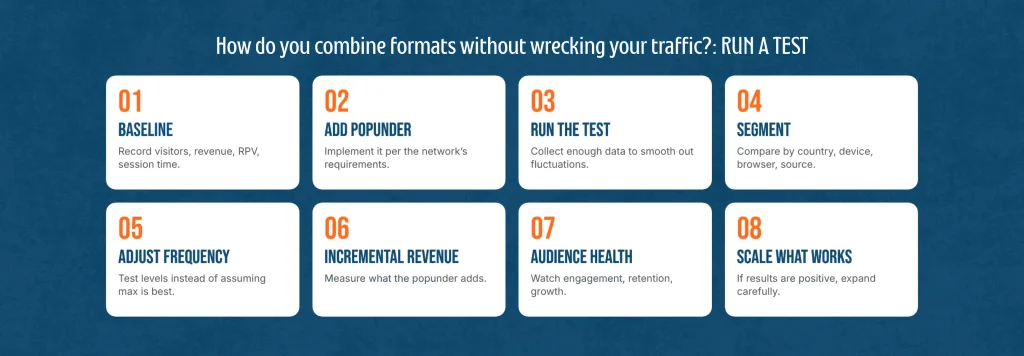
Here’s a simple approach we’d suggest:
- Record your baseline. Revenue, session length, bounce rate and pages per session.
- Add one format. Don’t change three things at once, or you’ll never know what caused what.
- Set a frequency cap. One popunder per user per session or per hour is a sensible starting point.
- Compare after two weeks. If revenue rose and engagement held steady, keep it.
- Layer the next format. Repeat.
It sounds slow, and honestly it is. But the publishers who skip this step are the ones who write angry forum posts about “ads ruining my traffic” three weeks later.
The Publisher’s Takeaway
Popunder advertising shouldn’t be viewed as a replacement for every other ad format. It should be viewed as another tool in your monetization stack.
The publishers that get the most from advertising are the ones that understand their traffic, test systematically, and optimize for sustainable revenue, not just short-term impressions.
If you already have the traffic, the next question is simple: how much more revenue could that traffic generate?
PopCash gives you global advertiser demand, flexible payouts and tools to control frequency, so you can test without guesswork.
FAQ
A popup opens in front of the page and interrupts the visitor immediately. A popunder opens behind the page, so the visitor sees it later. Popunders are generally seen as less disruptive for that reason.
Often, yes. A popunder delivers a full-page ad view per impression, while banners compete for a small share of attention. Results still vary by geo, niche and traffic quality.
There isn’t a single best format. Content sites often do well with native and banners, utility and streaming sites with popunders, and apps with interstitials. Most publishers earn more by combining two or three.
High-volume publishers are often well positioned to test popunders because even a relatively small amount of incremental revenue per visitor can become meaningful at scale.
Yes, publishers can potentially combine multiple formats. The important consideration is whether the combined experience produces sustainable incremental revenue and complies with the applicable policies and requirements.
