

Most pop ad creatives fail for the same reason: they describe an offer instead of triggering a reaction. Pop traffic gives you a fraction of a second of undivided attention, the visitor didn’t search for your ad, they collided with it, so the creatives that convert aren’t the cleverest or most polished ones, they’re the ones that hijack a specific, well-documented psychological response before the visitor’s brain has time to object.
This guide breaks down the seven triggers we see driving the biggest CTR and conversion lifts across PopCash’s pop inventory, with the exact copy patterns and layout choices behind each one.
TL;DR:
- The highest-converting pop traffic creatives lean on a small set of proven psychological triggers, urgency, scarcity, curiosity gap, social proof, fear of missing out (FOMO), authority, and reciprocity, often combining two or three in a single creative.
- Data from PopCash's network shows urgency-based creatives lifting CTR by up to 35% over neutral copy, while curiosity-gap headlines can double time-to-click engagement in content and entertainment verticals.
- The trigger that works best depends on your vertical: finance and software convert best on authority and social proof, while dating and entertainment respond strongest to curiosity and FOMO.
- Below, we break down each trigger, show real before/after copy examples, and give you a testing framework to find what converts on your own traffic.
What Are Psychological Triggers in Advertising?
A psychological trigger is a specific mental shortcut, a cognitive bias or emotional reflex, that an ad creative activates to prompt an immediate action, before the viewer consciously evaluates the offer.
These triggers aren’t manipulation tricks invented by marketers; they’re documented behavioral patterns that your brain uses constantly to make fast decisions with limited information, which is exactly the condition a visitor is in when a pop ad appears.
The reason this matters more in performance advertising than in branding is timing: a pop ad has roughly 1–3 seconds of attention before the visitor decides to engage or close it. There’s no time for a persuasive argument, only time for a trigger.
Why Do Psychological Triggers Matter More for Pop Traffic?
Psychological triggers matter more in pop traffic than in search or social because the visitor has zero intent signal to work with, they didn’t ask for this ad, so the creative has to manufacture the motivation to act on its own. In search advertising, the user’s query already tells you what they want. In pop traffic, you’re starting from a cold, often distracted visitor, which means the creative itself carries the entire persuasive load.
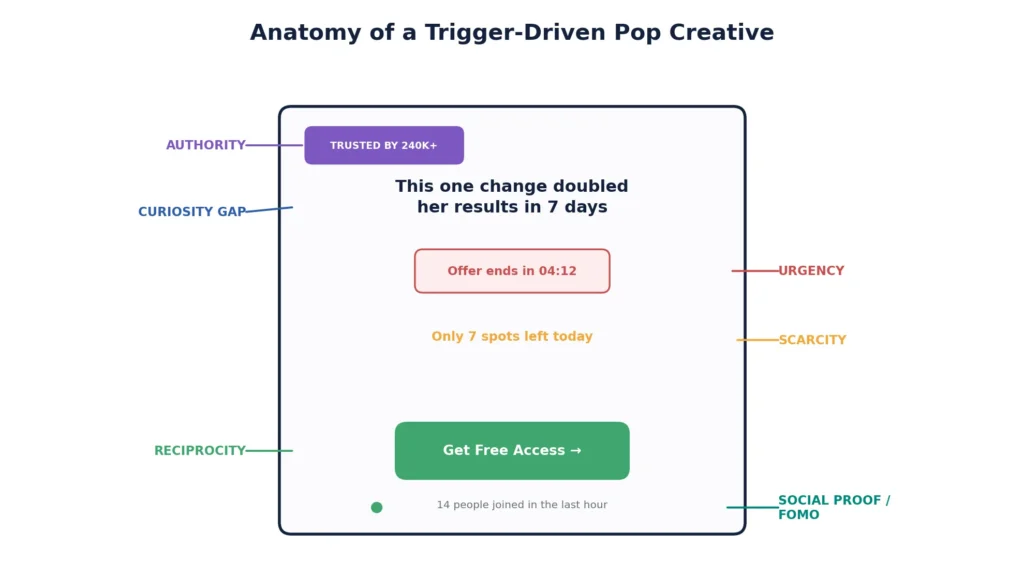
This is also why generic value-proposition copy (“Best prices, guaranteed!”) consistently underperforms trigger-based copy in pop placements: it asks the visitor to evaluate a claim, which takes time they don’t intend to spend. Trigger-based copy instead produces a reflex.
What Is Urgency and How Does It Boost Pop Ad Conversions?
Urgency works by shortening the visitor’s decision window artificially, making inaction feel like the riskier choice, and in PopCash’s data, urgency-led creatives outperform neutral copy by up to 35% in CTR. The mechanism is simple: humans weigh potential loss more heavily than potential gain (loss aversion), so a countdown or deadline reframes “I’ll skip this” as “I’ll lose this.”
Copy patterns that work:
- Countdown timers (“Offer ends in 04:12”)
- Deadline framing (“Only available today”)
- Action-window framing (“Spots close at midnight”)
Why it works especially well in: finance, e-commerce, software trials, limited-time promos.
What Is Scarcity and Why Does It Drive Clicks?
Scarcity drives clicks by signaling that supply is limited, which triggers the same loss-aversion response as urgency but applies it to quantity instead of time. The two are often combined, but scarcity works even without a deadline, “Only 3 left” is compelling on its own because it implies other people are already acting on the same offer.
Copy patterns that work:
- Stock counters (“Only 7 units remaining”)
- Access limits (“Limited to the first 100 signups”)
- Exclusivity framing (“Invite-only access”)
Why it works especially well in: software/SaaS trials, gaming beta access, exclusive deal verticals.
What Is the Curiosity Gap and How Do You Trigger It?
The curiosity gap is the discomfort created when someone is shown that information exists but not what it is, and closing that gap by clicking becomes more compelling than the actual content itself. This is the mechanism behind almost every “You won’t believe what happened next” headline, and while it’s overused to the point of parody in some verticals, it remains one of the highest-CTR triggers in entertainment and content-driven pop traffic when used with a specific (not vague) tease.
Copy patterns that work:
- Partial reveals (“She opened the box and immediately regretted it”)
- Specific-but-incomplete numbers (“This one change increased results by 340%”)
- Direct address with a withheld detail (“The reason your [X] isn’t working”)
Why it works especially well in: entertainment, content/news, health and lifestyle niches.
A word of caution: curiosity-gap creatives that oversell and underdeliver spike bounce rate and tank advertiser trust in the long run, pair the tease with a landing page that actually pays it off.
What Is Social Proof and How Do You Show It in a Pop Creative?
Social proof works by showing that other people have already taken the action you want the visitor to take, which lowers perceived risk because humans default to following the crowd under uncertainty. In a pop creative, this rarely means a full testimonial, you have seconds, not paragraphs, so the most effective versions are compressed into a single data point or visual cue.
Copy patterns that work:
- Numbers (“Join 240,000+ users”)
- Live-activity framing (“14 people signed up in the last hour”)
- Rating shorthand (“4.8★ from 12,000 reviews”)
Why it works especially well in: finance, software, health and wellness, anywhere trust is the main barrier to conversion.
What Is FOMO and How Is It Different from Urgency?
FOMO (fear of missing out) is driven by social exclusion, not by a ticking clock, it works by implying that other people are already enjoying a benefit the visitor doesn’t yet have, which makes urgency and scarcity feel personal rather than transactional. Urgency says “time is running out”; FOMO says “everyone else is already in.” They’re frequently combined, but FOMO alone can convert without any deadline at all.
Copy patterns that work:
- Social exclusion framing (“Everyone’s already talking about this”)
- Peer benchmarking (“See what your neighbors are earning”)
- Trend framing (“The app everyone switched to in 2026”)
Why it works especially well in: dating, social apps, entertainment, trend-driven products.
What Is Authority Bias and How Do You Borrow It?
Authority bias makes people more likely to trust and act on a claim when it appears to come from an expert, institution, or recognized source, and in a pop creative, you borrow this instantly through logos, credentials, or official-sounding language rather than through argument. This is one of the fastest triggers to process visually, since a recognizable badge or seal communicates credibility in under a second, faster than any sentence could.
Copy patterns that work:
- Credential framing (“Recommended by financial advisors”)
- Institutional cues (“As seen on [recognizable outlet]”)
- Data-backed authority (“Based on 3 years of clinical research”)
Why it works especially well in: finance, health, legal/insurance, B2B software.
What Is Reciprocity and Can It Work in a Single Impression?
Reciprocity is the instinct to return a favor, and yes, it works in a single pop impression when the creative leads with something given, a free resource, tool, or piece of value, rather than something asked for.
It’s the weakest of the seven triggers to compress into pop-length copy since it depends on a genuine sense of “getting” before “giving,” but it’s highly effective for lead-gen and freemium offers where the ask is small (an email) relative to the perceived gift.
Copy patterns that work:
- Free-first framing (“Get your free [tool/report/guide], no card required”)
- Value-before-ask (“We’ll calculate your savings for free”)
Why it works especially well in: lead generation, freemium SaaS, financial calculators/tools.
Psychological Triggers Compared: Which Converts Best by Vertical?
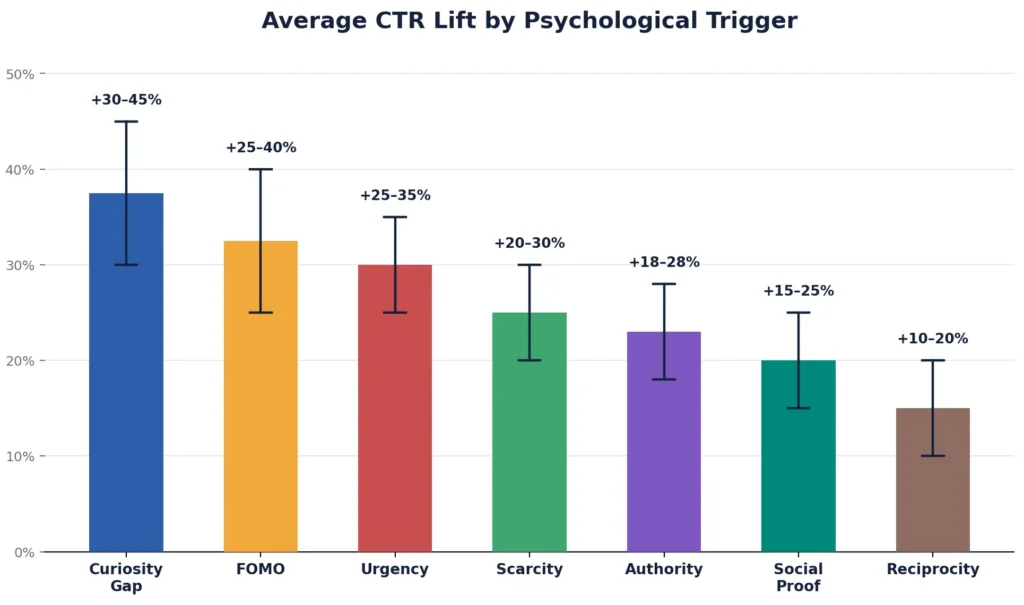
Urgency and scarcity perform best in finance and e-commerce, while curiosity and FOMO dominate entertainment and dating, matching the trigger to the vertical typically outperforms using the same trigger everywhere by a wide margin.
Use the table below as a starting point, then validate with your own split tests.
| Trigger | Best-Fit Verticals | Avg. CTR Lift* | Combine Well With |
|---|---|---|---|
| Urgency | Finance, e-commerce, software trials | +25% to +35% | Scarcity |
| Scarcity | SaaS, gaming, exclusive deals | +20% to +30% | Urgency, Social Proof |
| Curiosity Gap | Entertainment, content, health/lifestyle | +30% to +45% | FOMO |
| Social Proof | Finance, software, health/wellness | +15% to +25% | Authority |
| FOMO | Dating, social apps, trend products | +25% to +40% | Curiosity Gap |
| Authority | Finance, health, legal, B2B software | +18% to +28% | Social Proof |
| Reciprocity | Lead-gen, freemium SaaS, calculators | +10% to +20% | Social Proof |
How Do You Test Psychological Triggers Without Wasting Budget?
Test one trigger at a time against a neutral control, run each variant to statistical significance before judging it, and only then start combining winning triggers, testing multiple triggers at once makes it impossible to know which one moved the number.
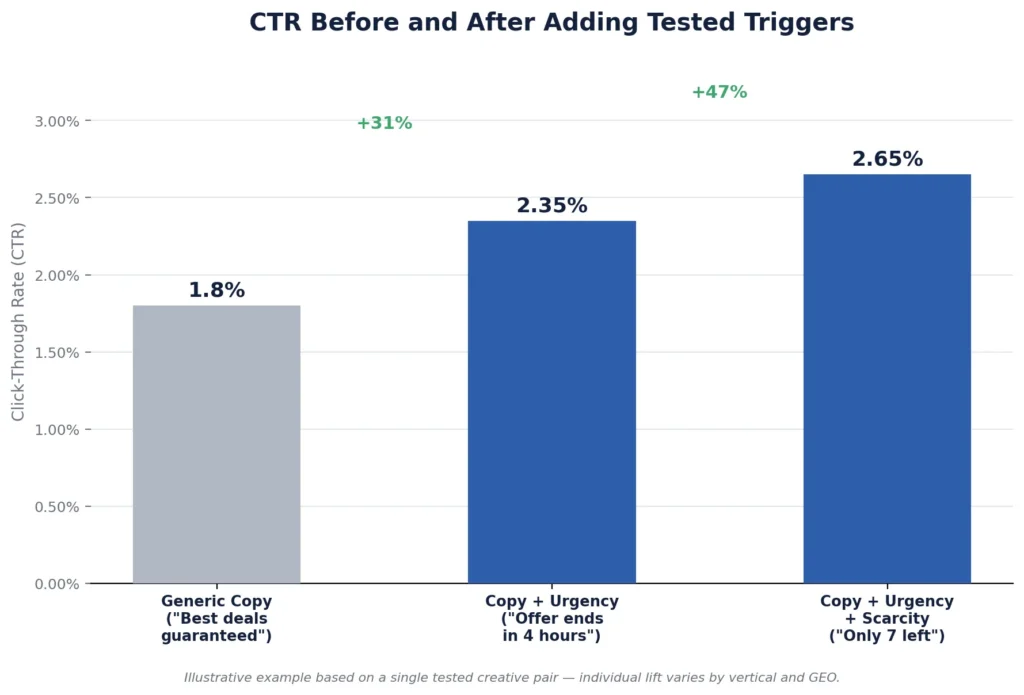
- Start with a neutral-copy control so every trigger’s lift is measured against a real baseline, not against another trigger.
- Isolate one variable per test, same layout, same CTA, only the trigger copy changes.
- Run to a meaningful sample size before calling a winner; small pop campaigns can show misleading early swings.
- Layer your second trigger only after the first has a proven lift, so you know which one is actually doing the work.
- Re-test quarterly, trigger fatigue is real, and what converts today can flatten out as an audience becomes desensitized to it.
Frequently Asked Questions
What is the most effective psychological trigger for pop ads?
There isn’t a single universal winner, curiosity gap and FOMO tend to produce the highest CTR lift overall, but urgency and authority outperform them specifically in finance and B2B verticals, so the right trigger depends on your niche.
Can I combine multiple psychological triggers in one creative?
Yes, and many top-performing creatives combine two, most commonly urgency with scarcity, or curiosity with FOMO, but you should validate each trigger individually first so you know which one is actually driving the lift.
Do psychological triggers work the same across all GEOs?
No, social proof and authority tend to translate well across most GEOs, while urgency and scarcity phrasing can need cultural adaptation, since directness around money or deadlines is received differently market to market.
Is using psychological triggers in ads manipulative?
Using well-documented decision-making patterns like urgency or social proof isn’t inherently manipulative, the line is crossed when the trigger overstates something untrue (fake countdowns, fabricated stock numbers), which also damages long-term conversion trust once visitors notice.
How long does a psychological trigger stay effective before it wears out?
Most trigger-based creatives start showing fatigue (declining CTR against the same audience) after several weeks of continuous exposure, which is why rotating and re-testing triggers on a quarterly basis is standard practice.
Do psychological triggers matter more for the creative or the landing page?
Both, but they need to match, a curiosity-gap creative that lands on a page failing to resolve that curiosity will spike bounce rate even if the initial CTR looks strong.
Start Applying These Triggers to Your Campaigns
Reading about triggers is step one, seeing which ones actually move your CTR is step two. PopCash’s creative reporting breaks down performance by trigger type and vertical, so you can see in real numbers which psychological angle is winning on your traffic instead of guessing from a blog post.
